Clinical Supervision
for Trainee, Newly Qualified
and Experienced Counsellors in Worthing and Online
A warm, collaborative space for
reflection and development
Whether you are a trainee, newly qualified or an experienced counsellor, supervision offers an opportunity to reflect on your work, develop your confidence and continue to grow as a practitioner.
My aim is to support you in providing ethical and effective counselling while attending to your own wellbeing and the emotional demands of the work.

How I see my role
As a supervisor, I see my role as:
• exploring client work, including what feels difficult, uncertain or stuck
• reflecting on the therapeutic relationship and the emotional responses it evokes
• considering ethical dilemmas, boundaries and professional responsibilities
• identifying learning and development needs
• offering constructive feedback and thoughtful challenge
• supporting the supervisee's confidence, professional development and wellbeing.
My approach to supervision
I approach supervision collaboratively, with an emphasis on reflection, learning and professional development. I aim to create a relationship in which you can explore your client work, consider different perspectives and develop your confidence in your practice.
I bring a strengths-based perspective to supervision, recognising what you already know and can do, as well as the areas where you may want to develop or where your work feels more difficult.
Who I work with
I work with counsellors at various stages in their professional journey.
- Trainees may need support in working with the uncertainties of client work, developing their confidence in the application of their knowledge and skills, exploring their use of self and understanding the supervisory relationship.
- Newly qualified counsellors may be navigating the transition into independent practice, developing their professional identity and finding their feet with increasingly complex client work.
- Experienced counsellors may want to reflect on familiar patterns, explore work that feels difficult or stuck, or consider how their own experience is influencing their understanding of a client. We can all have blind spots or become emotionally involved in ways that are difficult to recognise independently.
What you can expect
The relationship between supervisor and supervisee has an important influence on the quality of supervision and, in turn, on client work. I aim to develop a collaborative and trusting relationship in which you can speak openly, explore difficulties and uncertainty, and reflect on your practice without feeling you have to present yourself as someone who already has all the answers.
As an experienced integrative counsellor and trained supervisor, I understand the emotional demands of counselling work. My background in senior management roles in communications, human resources and learning and development within a large public sector organisation also informs my approach. I value constructive feedback, empathy and thoughtful challenge, and recognise the importance of acknowledging what is going well as well as exploring what might need to change.
Supervision is also an opportunity to look after yourself as a practitioner. Taking time to reflect on the emotional impact of your work can help you recognise when you are becoming tired, overwhelmed or less able to remain compassionate. I aim to offer a confidential and supportive relationship in which these aspects of your work can be explored alongside your professional development.
Making the most of supervision
Supervision is a collaborative process. I encourage you to think about what you need from each session and what you would like to take away from it.
Sometimes you may arrive with a particular client or professional issue you want to explore. At other times, you may be feeling unsettled, uncertain or unsure where to begin.
We can work together to identify what would be most helpful, whether that involves exploring a particular situation, reflecting on your responses, considering different perspectives or making space for the emotional demands of your work.
I welcome openness about what feels difficult to discuss, including anything that may be happening within the supervisory relationship itself. I strongly believe we can learn from both our successes and our mistakes.
If it helps, you might find it useful to think about:
- What would you like to take away from the session?
- Is there a particular client or situation you want to explore?
- Is there anything you have not yet brought to supervision?
- Are there skills or areas of practice you would like to develop?
The supervision models that inform my work
I have a Diploma in Integrative Supervision of Individuals and Groups from The Grove.
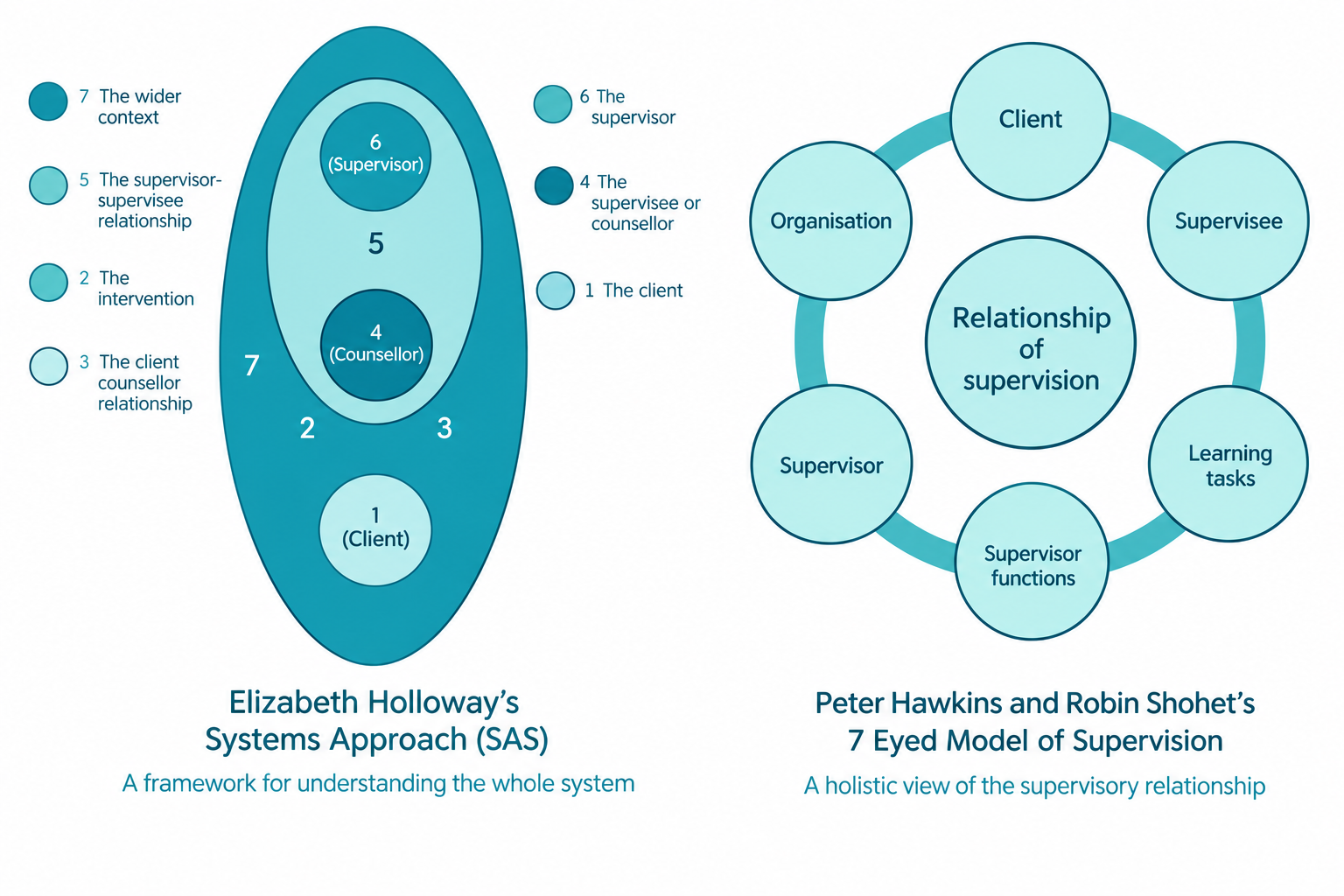
My supervisory practice is informed by Elizabeth Holloway’s Systems Approach to Supervision and Hawkins and Shohet’s Seven-Eyed Model. Both help me consider the wider context of counselling alongside the relationships at the heart of the work.
Holloway’s Systems Approach to Supervision
Holloway’s Systems Approach to Supervision (SAS) identifies seven interconnected dimensions: the supervisee and supervisor; the supervisee’s learning tasks; the supervisor’s teaching strategies; the client; the organisation, and the supervisory relationship itself. It also recognises the significance of cultural factors in supervision, and the unique nature of each supervisor–supervisee relationship
.
What I particularly value in Holloway’s model is the central place given to the supervisory relationship. It provides the context in which the supervisee can reflect on their work, develop their understanding and continue to grow professionally.
Hawkins and Shohet’s Seven-Eyed Model
I draw particularly on Hawkins and Shohet’s Seven-Eyed Model to explore different aspects of counselling practice together with supervisees. This includes the client’s presentation, the counsellor’s interventions, the therapeutic relationship, the supervisee’s process, the supervisory relationship, my own process as supervisor, and the wider context of the work.
The model offers a way of looking at client work from different perspectives, helping us to explore what may be happening in the therapeutic relationship, consider our responses and develop a deeper understanding of the work.
Practical arrangements
Fees
- Clinical supervision: £60 for 90 minutes
- Student counsellors: £45 for 90 minutes
Location
I offer supervision face-to-face in Worthing and online using a secure video platform.
Online supervision is available to counsellors across the UK.
Frequency
I offer monthly supervision, with fortnightly sessions available where this is helpful, particularly for trainees or counsellors working with a complex or demanding caseload.
Ethics, safeguarding and boundaries
How I handle ethical dilemmas
My supervision practice is informed by the BACP Ethical Framework for the Counselling Professions.
When an ethical dilemma arises, I work collaboratively with the supervisee to explore the situation, identify the issues involved and consider possible courses of action. I use Socratic questioning and ethical decision-making models to support this process.
The limits of confidentiality within supervision.
Records I keep are factual, adequate and relevant for the supervision service I offer. All communications, notes and other information held are stored securely and comply with the UK’s data protection requirements. They are retained as required by my insurer.
Total confidentiality cannot be guaranteed. Clients’ needs or the public interest may potentially outweigh the duty of confidentiality and in some circumstances, the law requires the disclosure of information that would otherwise be confidential.
Should I consider breaching confidentiality, I will consider the reliability of the information, and all ethical, legal and practical factors relevant to the situation. And I will only do so in the knowledge that should my decision be challenged, I could justify the action to myself, my supervisee, my supervisor.
Get in touch
Enquiring about supervision
I offer a free 30-minute supervision consultation, giving us an opportunity to discuss your supervision goals and consider whether our approaches and expectations are a good fit.
It is also an opportunity for you to ask questions and get a sense of whether working together feels right for you.
I offer supervision face-to-face in Worthing and online.
If you would like to arrange an initial consultation, please use the contact form and I will get back to you.
Before we begin
a few things you might be wondering about
Are you a trained clinical supervisor?
Yes. I have a Diploma in Integrative Supervision of Individuals and Groups from The Grove and am a BACP member. My supervisory practice is informed by Hawkins and Shohet’s Seven-Eyed Model and Elizabeth Holloway’s Systems Approach to Supervision.
Where do sessions take place?
I offer face-to-face supervision in Worthing and online using a secure video platform. Online supervision is available to counsellors across the UK.
Do you supervise trainees on placement?
Yes. I work with trainee counsellors on placement or building hours towards qualification, as well as newly qualified and experienced practitioners.
For trainees, I can provide the documentation and end-of-placement reports required by their training course or placement, and we will agree arrangements for this as part of our supervision contract.
How often do we meet?
I usually offer monthly supervision, with fortnightly sessions available where this is helpful, particularly for trainees or counsellors working with a complex or demanding caseload.
Which counselling approaches do you work with?
My approach to supervision is integrative.
I work with your clinical framework rather than imposing my own, recognising that the therapeutic relationship is central to counselling, whatever the modality.
I particularly welcome counsellors working from integrative, humanistic, existential and person-centred approaches.
Can I have personal therapy and supervision with you?
I offer both personal therapy for counsellors and clinical supervision, but not to the same person.
Combining personal therapy and professional supervision can create a dual relationship, potentially blurring boundaries and affecting the openness and objectivity needed in both relationships.
© Caring Counselling Worthing
powered by WebHealer